How to Pack a Gym Bag That Fits Under Your Desk
Quick Answer: Most gym bags are twice the size they need to be because they carry things that could live in a locker, duplicate things the gym provides, and are packed loose rather than rolled. A workable office gym bag is 20 to 25 litres, holds one outfit rolled, one pair of shoes in a separate compartment or bag, a microfibre towel and a small toiletry pouch. Everything else - shampoo, spare kit, equipment, dry shoes - belongs in a locker or at home.
The bag is enormous, half of it is things you did not use, and it does not fit anywhere.
The problem is not the bag. It is the inventory.
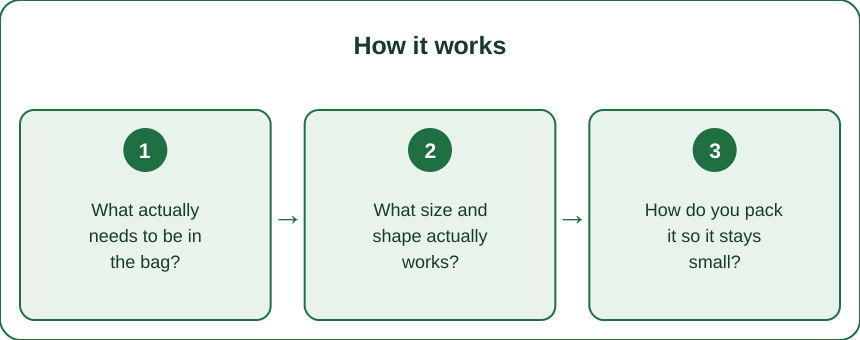
What actually needs to be in the bag?
Considerably less than most people carry, once you separate daily items from base-camp items.
The genuine daily list, for a standard training session:
- Training top and bottoms - one set, rolled
- Sports bra and socks
- Training shoes - the single largest item
- A microfibre towel - a quarter the packed volume of a cotton one
- A small toiletry pouch - deodorant, a solid or decanted body wash, a hair tie
- A water bottle, ideally collapsible or filled at the gym
- Underwear and anything else needed for the return to work
That is it. Everything below belongs somewhere other than the bag you carry:
- Shampoo, conditioner, body wash in full-size bottles - decant into 50ml containers or leave a set in a locker
- A second full outfit for tomorrow - carry one day at a time
- Resistance bands, straps, a foam roller, gloves - locker items, not daily items
- Post-workout snacks and shakers, unless you genuinely use them every time
- A hair dryer, if the gym has them
- Multiple towels
The locker is the single biggest lever available. Even a small paid locker changes the daily bag from a 35 litre holdall to a 20 litre backpack, and most gyms rent them for a modest monthly fee. Put toiletries, spare socks, a backup t-shirt and any equipment in there and never carry them again.
A useful audit: for two weeks, put a small mark on anything you actually take out of the bag and use. At the end of it, remove everything unmarked. Most people find a third of the contents have not moved.
What size and shape actually works?
20 to 25 litres, with a separate shoe compartment, and a shape that sits flat.
Volume: 20 litres is enough for one outfit, shoes, a microfibre towel and a small pouch if you roll rather than fold. 25 litres gives comfortable margin. Above 30 litres you will fill it with things you do not need, because bags get filled to their capacity.
Shape matters more than volume for the under-desk problem. A boxy rectangular bag stows far better than a round duffel, which rolls, sags and takes up floor space in every direction. A backpack with a flat back panel stands upright against a desk leg.
Features that genuinely earn their place:
- A separate bottom shoe compartment - keeps dirt away from clothes and lets you use the awkward bottom space efficiently
- A dedicated wet pocket, waterproof-lined, for a damp towel or swimsuit
- An external bottle pocket, so the bottle is not inside taking cylindrical space
- A laptop sleeve, if the same bag is doing the commute - this is what makes one-bag work
- Compression straps, which reduce the packed size of a partly full bag noticeably
Features that are usually not worth it: multiple small organiser pockets, which fragment the space; heavy hardware and structured panels, which add weight and bulk; and ventilated compartments, which sound good and rarely have enough airflow to matter.
Material affects both weight and longevity. A coated nylon or polyester in the 400 to 600 denier range is the practical sweet spot - light, durable enough, and wipes clean. Heavy canvas looks good and weighs considerably more.
On the one-bag versus two-bag question: one bag is better if it has a laptop sleeve and you can live with 25 litres. Two bags - a work bag and a small gym bag - is genuinely fine and often more practical, and a 15 litre packable gym bag that folds into itself weighs almost nothing when empty.
How do you pack it so it stays small?
Roll, use the shoes as containers, and pack in the order you will unpack.
Roll everything, tightly. Rolled clothing takes noticeably less volume than folded and creases less. Roll the top and bottoms together as one bundle rather than separately - it is more compact and comes out as a unit.
Use the shoes. Socks, a hair tie and a small deodorant fit inside training shoes and that space is otherwise wasted entirely. This is the single most effective packing trick for a gym bag.
Packing order, bottom to top:
- Shoes in the bottom compartment, stuffed with socks and small items
- The rolled clothing bundle in the main compartment
- Microfibre towel rolled alongside
- Toiletry pouch at the top or in an outer pocket, since you want it first at the other end
- Bottle in the external pocket
Pack in reverse order of use so you are not unpacking the whole bag in a changing room to find the thing you need first.
Volume-saving swaps that add up:
- Microfibre towel instead of cotton - roughly a quarter of the packed volume and dries far faster
- Solid shampoo and conditioner bars - no bottles, no leak risk, no liquid limits
- A collapsible water bottle, which flattens to nothing when empty
- Decanted 50ml containers instead of full-size anything
- Thin technical fabric over cotton across the board - it packs smaller and dries faster
The maintenance side, since a small bag concentrates smells:
- Take everything out the same day, every day. This is the whole hygiene routine
- Leave the bag open overnight to dry out
- Wipe the shoe compartment weekly
- Wash the bag itself monthly if the material allows, or wipe it out with a dilute vinegar solution
And a small item worth carrying: a lightweight drawstring bag folded flat in an outer pocket. It costs no space and gives you somewhere to isolate damp kit on the way home, which is the main cause of everything else in the bag smelling.
What Nobody Tells You About Office Gym Bags
Six things that make the difference between a system that lasts and one you abandon in three weeks.
Bags get filled to their capacity regardless of need. Buy the size you want to carry, not the size that fits everything you might want. A 35 litre bag will always end up weighing more than a 22 litre one, whatever your intentions.
A locker is worth more than a better bag. Even a small rented locker removes toiletries, equipment and backup kit from the daily carry permanently. It is the single highest-return change available and most people never consider it.
Shoes are the volume problem, not the clothes. One pair of trainers occupies more space than a full outfit rolled. If you can leave shoes at the gym, the bag halves. If not, the bottom compartment is the only sensible place for them.
Damp kit contaminates everything else. A wet towel or sweaty top in a closed bag for eight hours transfers moisture and odour to every other item. A flat drawstring bag in an outer pocket solves it for almost no space.
Packing the night before is the actual habit. The bag being ready is what determines whether you go, more than motivation does. Packing in the morning is where the plan usually breaks down.
And the one that surprises people: two bags often beats one. A packable 15 litre gym bag that folds flat into your work bag means you carry one bag in and have a proper gym bag when you need it. It is more flexible than trying to make a single bag do both jobs.
FAQ: Office Gym Bag Questions, Answered
What size bag do I actually need?
Twenty to twenty-five litres for one outfit, shoes, a microfibre towel and a small pouch, packed with rolling rather than folding. Above thirty litres you will simply carry more, because bags get filled to their capacity regardless of what you intended.
What can I leave at the gym?
Toiletries, equipment like bands and straps, a backup t-shirt and socks, and ideally shoes. Even a small rented locker changes the daily carry more than any bag upgrade would, and most gyms offer them cheaply.
How do I stop the bag smelling?
Empty it completely the same day, every day, and leave it open overnight to dry. A flat drawstring bag in an outer pocket keeps damp kit isolated on the way home, which is where most of the odour transfer happens.
Is one bag or two better?
One works if it has a laptop sleeve and you can live with twenty-five litres. Two is genuinely more flexible - a packable fifteen litre gym bag folds into your work bag and weighs almost nothing when you are not using it.
What is the single best packing trick?
Stuffing socks and small items inside your shoes. That space is otherwise completely wasted, and it is the difference between a bag that closes easily and one that does not.
Microfibre or cotton towel?
Microfibre, without much argument. It packs to roughly a quarter of the volume, dries far faster, and does not sit damp in the bag all afternoon. Cotton towels are the second largest volume item after shoes.
TL;DR:
- The problem is the inventory, not the bag - most people carry a third more than they use
- A locker for toiletries, equipment and backup kit is the highest-return change available
- Target 20 to 25 litres, boxy rather than round, with a separate bottom shoe compartment
- Roll clothes as one bundle, stuff socks and deodorant inside the shoes
- Microfibre towel, solid shampoo bars, collapsible bottle - each saves real volume
- Empty the bag the same day and leave it open overnight; a flat drawstring bag isolates damp kit
- Pack the night before, because a ready bag is what determines whether you go
Audit for two weeks and remove anything you never took out. It will be more than you think.
See It in Motion
Seen here: Super High Waist Embossed Yoga Leggings with Inner Pocket — shop it on bubblelime.com
Keep Reading
This article is for general informational and styling purposes only. Fit, sizing, and product availability may vary.