Why Your Gym Bag Strap Always Breaks First — and How to Buy One That Won't
Quick Answer: Gym bag straps fail first because the hardware (D-rings, stitching anchors, zipper pulls) is rated for far less repeated stress than the fabric — check the stitching density and metal hardware, not just the material, before buying.
You bought a gym bag that looked tough, and eight months later the strap is hanging by a thread while the rest of the bag looks brand new. That’s not bad luck — it’s a predictable failure point that most shoppers never think to check.

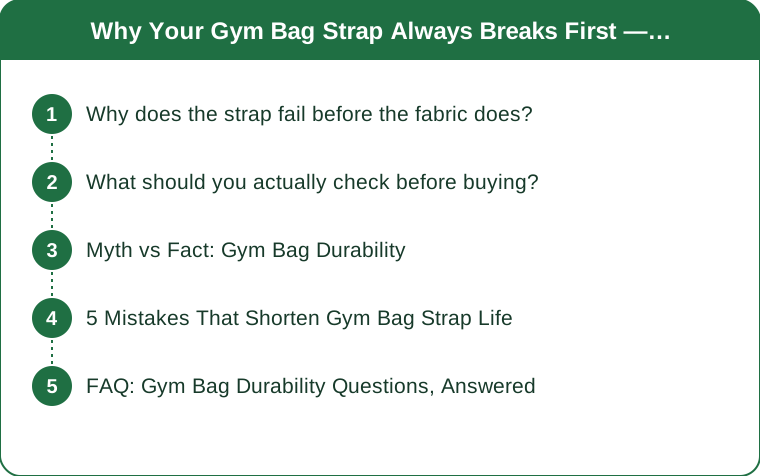
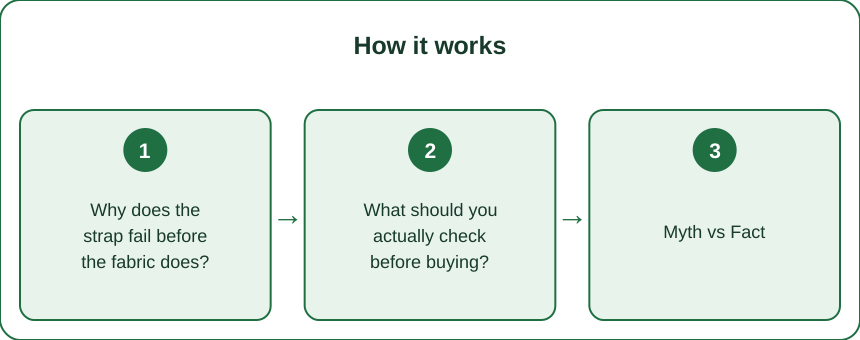
Why does the strap fail before the fabric does?
The strap carries concentrated, repeated stress at just two or three points — the anchors where it attaches to the bag body. Every time you sling a wet, loaded bag over one shoulder, that anchor point takes the full weight in a small stitched area, while the rest of the bag fabric barely flexes at all.
Cheap bags reinforce the fabric (thicker canvas, bigger prints) but skip reinforcing the anchor points, so you get a bag that looks rugged everywhere except the one spot that actually needs it.
What should you actually check before buying?
Look for bar-tack stitching (a small dense rectangle of stitches, not a single straight line) at both strap anchors — this is the single biggest predictor of strap longevity. Also check whether the D-rings are welded metal loops sewn into a fabric webbing loop, rather than plastic clips riveted directly through the bag panel.
A quick in-store test: pull the strap hard away from the bag at an angle for a few seconds. Any visible puckering or thread give at the anchor point is a preview of what six months of daily use will do.

Myth vs Fact: Gym Bag Durability
Myth: A thicker, heavier-duty fabric means a longer-lasting bag. Fact: Fabric weight barely matters for strap failure — it’s almost entirely about anchor stitching and hardware quality, which you often can’t tell from fabric alone.
Myth: Bags from outdoor/hiking brands are automatically better built than gym-specific brands. Fact: Some are, but plenty of gym-specific brands from serious activewear companies use the same or better bar-tack construction — brand category isn’t a reliable shortcut, checking the stitching is.
5 Mistakes That Shorten Gym Bag Strap Life
1. Always slinging on the same shoulder. Alternating sides distributes wear across both anchor points instead of destroying one.
2. Overloading past the bag’s intended capacity. A bag rated for a light daily kit stuffed with wet towels and shoes daily stresses the anchors far beyond design spec.
3. Leaving it wet for days. Damp stitching threads weaken faster than dry ones — air it out after sweaty sessions.
4. Yanking the strap to adjust length under load. Adjust before loading the bag, not while it’s full and swinging.
5. Ignoring early fraying. A single loose thread at the anchor is a warning sign, not a cosmetic issue — it’s the start of the failure point.
FAQ: Gym Bag Durability Questions, Answered
Can a broken gym bag strap be repaired instead of replacing the whole bag?
Often yes — a shoe or luggage repair shop can re-stitch or replace a strap anchor for a fraction of a new bag’s cost, especially on an otherwise-good bag.
Is a crossbody strap more durable than a single shoulder strap?
Generally yes, since weight distributes more evenly and there’s less repetitive one-sided stress on a single anchor point.
Does price reliably predict gym bag durability?
Not perfectly, but bags in the middle price range from established activewear brands tend to invest more in stitching quality than the cheapest bargain-bin options.
TL;DR:
- Straps fail at stitched anchor points long before the fabric wears out
- Bar-tack stitching and welded metal D-rings are the real durability signals, not fabric thickness
- Alternating shoulders and airing the bag out after sweaty sessions extends strap life
- A single fraying thread at the anchor is your early warning — don’t ignore it.
See It in Motion
Seen here: Super High Waist Embossed Yoga Leggings with Inner Pocket — shop it on bubblelime.com
Keep Reading
This article is for general informational and styling purposes only. Fit, sizing, and product availability may vary.